Introduction

If you are engaged in digital marketing or wish to run advertisements for your business, one of the most common points of confusion arises: Google Ads vs Facebook Ads—which delivers a better ROI?
This question is not limited to beginners alone; even experienced marketers constantly re-evaluate it, as these platforms continue to evolve year after year. In 2026, competition has intensified significantly, CPCs are on the rise, and audience behavior has also undergone a transformation.
Many people run ads without a proper strategy and then complain that they aren’t seeing results. In this guide, we will deeply compare Google Ads vs Facebook Ads to help you choose the right platform. The reality is that the problem lies not with the platform itself, but rather with the way it is utilized.
In this blog, we will delve deep into understanding the actual differences between Google Ads and Facebook Ads, determine which platform to use and when, and learn how you can generate maximum ROI for your business without wasting your budget.
Google Ads vs Facebook Ads: Understanding the Basic Concepts
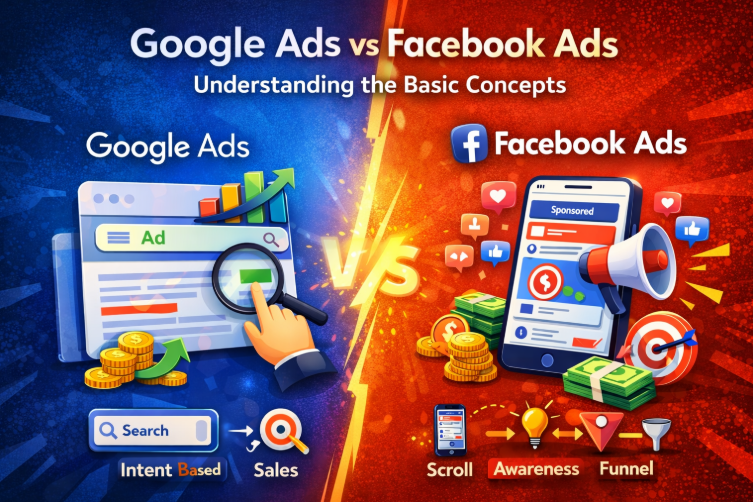
First and foremost, it is crucial to clarify the basics; because if your foundation isn’t clear, any subsequent strategy will never prove effective. The primary difference between Google Ads and Facebook Ads lies in their operating models. Google Ads is an intent-based platform, whereas Facebook Ads is an interest-based platform.
In Google Ads, the user actively searches for a specific product or service. This means they already have a need for Google Ads vs Facebook Ads. For instance, if someone searches for “best gym near me” or “digital marketing agency,” they are already interested in making a purchase or availing a service. Consequently, the chances of conversion are naturally high in this scenario.
On the other hand, with Facebook Ads, the user is scrolling, and you display an ad right in front of them. They haven’t specifically searched for anything, but you target them based on their interests and behavior. Consequently, the process here involves first creating awareness, followed by interest, and finally, conversion. For this very reason, the two platforms are utilized with distinct strategies.
Audience Intent: Google Ads vs Facebook Ads Biggest Difference
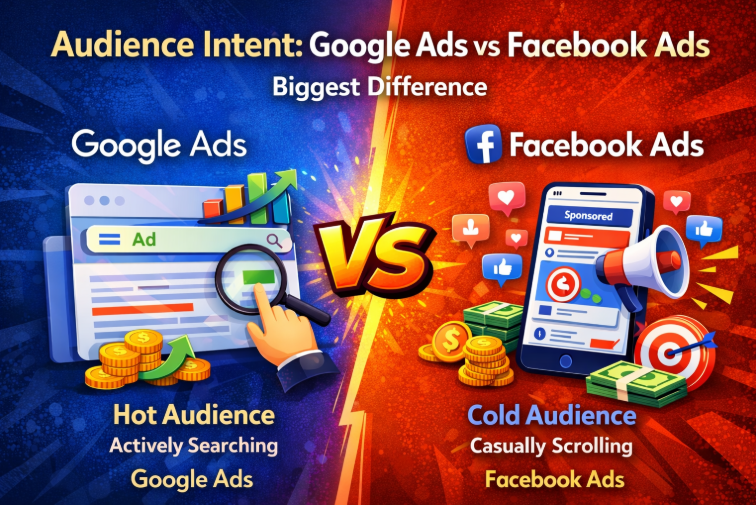
If you are talking about ROI, the most important factor is audience intent. This is the biggest difference between Google Ads and Facebook Ads—one that completely alters the results. The audience that comes through Google Ads is a “hot audience,” meaning they are already actively searching for a solution. They simply need the right option.
For example, if someone searches for “best dentist in Bahadurgarh, or Google Ads vs Facebook Ads ” they are clearly in the mood to avail a service. If your ad appears before them, the chances of conversion are quite high. This is why Google Ads is referred to as a high-intent platform.
The situation is slightly different with Facebook Ads. Here, the audience is “cold”—meaning they haven’t even realized they have a need yet. You first have to grab their attention, then build their interest, and finally push for a conversion. That is why a funnel approach is essential in Facebook Ads.
Cost Comparison: Budget Role of Google Ads vs Facebook Ads
Whenever a business begins running advertisements, the very first thing it considers is the cost. The cost structures for Google Ads and Facebook Ads differ significantly. In Google Ads, the CPC (Cost Per Click) is generally higher because the competition is intense and involves bidding on keywords. In certain industries, the CPC can even range from ₹50 to ₹500.
Facebook Ads provides comparatively cheaper traffic. Here, the CPC can range anywhere between ₹2 and ₹20, depending on the niche and targeting. In Google Ads vs Facebook Ads Consequently, beginners often perceive Facebook Ads as the better option simply because the cost is lower. However, focusing solely on the cost is an incorrect approach.
The real game is all about ROI. If you are generating ₹1,000 in earnings from a ₹100 click (via Google Ads), that is far better than a ₹10 click that yields zero return (via Facebook Ads). Therefore, it is crucial to consider conversions and revenue alongside the cost. In Google Ads vs Facebook Ads Smart marketers focus not merely on cheap traffic, but on profitable traffic.
Conversion Rate: Which Platform Generates More Sales?
Conversion rate is a factor that directly impacts ROI. When comparing Google Ads versus Facebook Ads, Google Ads generally yields a higher conversion rate because the user is already in search mode. They are close to making a decision and simply select the best available option.
In Facebook Ads, the conversion rate is initially low—especially when you target a cold audience. Here Google Ads vs Facebook Ads, you first need to build trust, create brand awareness, and provide the user with multiple touchpoints. Conversion rates improve in retargeting campaigns because, by that stage, the user has already become familiar with your brand.
This does not mean that Facebook Ads don’t work. Rather, it means that Facebook Ads must be utilized properly in conjunction with a funnel. If you attempt a direct sale without warming up the audience, the results will be lackluster. While direct conversions are possible with Google Ads, nurturing is essential with Facebook Ads.
Brand Awareness: Why Do Facebook Ads Dominate?
When it comes to awareness, Facebook Ads is the clear winner in the Google Ads vs Facebook Ads comparison. People visit platforms like Facebook and Instagram for entertainment, and on these platforms, you can show them visually attractive ads. Here, creativity plays a pivotal role.
Through Facebook Ads, you can reach your brand out to hundreds of thousands of people at a low cost. Video ads, Reels, and carousel ads—all these formats boost engagement and recall. This creates long-term brand value, which aids in future conversions.
In Google Ads vs Facebook Ads, Awareness Ads is limited in Google Ads because it is primarily search-based. While display ads and YouTube ads can be utilized for awareness purposes, it is difficult to achieve the same level of virality and engagement found on Facebook Ads. Therefore, if you are a new brand or looking to build your identity, Facebook Ads is a strong option.
Which is better for a local business?
For local businesses, the decision in In Google Ads vs Facebook Ads, becomes somewhat easier. Google Ads tends to be more effective in this context because people directly conduct “near me” or location-based searches—such as “salon near me” or “best restaurant in Bahadurgarh.” These are high-intent searches, where the chances of conversion are significantly high.
Facebook Ads also allows for local targeting, but the user intent there is not as strong. The user is typically scrolling casually when they come across your ad. If the creative is compelling, it may generate interest; however, In Google Ads vs Facebook Ads the likelihood of an immediate conversion is lower compared to Google Ads.
The best approach is for a local business to utilize both platforms. Use Facebook Ads to generate awareness, and Google Ads to capture customers who are ready to buy. This improves your overall ROI and ensures the business receives a consistent stream of leads.
Best Strategy in 2026: How to Combine Google Ads and Facebook Ads?
In 2026, smart marketers do not rely on a single platform. Rather than comparing Google Ads vs Facebook Ads, combining them constitutes a far more powerful strategy. This allows you to construct a full-funnel approach that generates maximum ROI in the long run.
First, create awareness using Facebook Ads. Educate your audience, engage them, and tell them about your brand. Subsequently, run retargeting ads to bring interested users back. Finally, use Google Ads to capture those users who are actively searching.
This strategy is known as full-funnel marketing. Google Ads vs Facebook Ads It covers the entire funnel—the top, middle, and bottom stages. The result is a reduction in your cost per lead and an increase in your conversion rate. This approach is sustainable in the long term, and serious businesses operate based on this very model.
Common mistakes that destroy a career.
Many people make fundamental mistakes while running ads that end up wasting their entire budget. When comparing Google Ads versus Facebook Ads, execution is far more important than the platform itself. The most common mistake is running ads without testing. Advertising is a game of testing; it is a mistake to expect perfect results from a single campaign.
The second mistake is incorrect targeting. If you are not reaching the right audience, even the best creative will fail. The third mistake is failing to create a landing page. Google Ads vs Facebook Ads The sole function of ads is to drive traffic; conversions happen on the landing page. If the page is not optimized, you won’t generate any leads.
Another major mistake is direct selling via Facebook Ads. Here, you need to build trust first. If you push for a direct sale without building a relationship, the results will be lackluster. By avoiding these mistakes, you can easily improve your ROI.
Final Verdict: Google Ads vs Facebook Ads-Which One Should You Choose?
If we look at the final conclusion, there is no single universal winner between Google Ads and Facebook Ads. It depends entirely on your business type, budget, and goals. If you need instant leads and want to target a high-intent audience, then Google Ads is the best choice.
If you want to build a brand, create awareness, and develop a long-term audience, then Facebook Ads is the better option. However, the most powerful strategy is to combine both.
Businesses thriving in 2026 do not rely on a single platform and compairing in Google Ads vs Facebook Ads Instead, they employ a data-driven approach, conduct rigorous testing, and build robust funnels. If you, too, adopt this smart approach, you can easily multiply the ROI of your ads and surge ahead of your competitors.
Our Next Post
FAQ Section
Which is better: Google Ads or Facebook Ads?
Google Ads is better for high-intent leads, while Facebook Ads is best for awareness and targeting.
Are Facebook Ads cheaper than Google Ads?
Yes, the CPC for Facebook Ads is generally lower, but it depends on the ROI strategy.
Which platform is best for small businesses?
Google Ads is a better option for small businesses if you are looking for direct leads.
Should both advertising platforms be used simultaneously? Google Ads vs. Facebook Ads Together
Yes, a combination of both platforms is best for a full-funnel strategy.
Our Social Media – Facebook and Instagram
Go to Home Page – Digixperto